Native America: A History by Oberg Michael Leroy
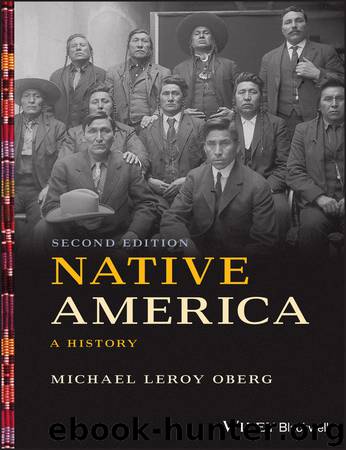
Author:Oberg, Michael Leroy [Oberg, Michael Leroy]
Language: eng
Format: epub
ISBN: 9781118937136
Publisher: Wiley
Published: 2017-05-30T04:00:00+00:00
Settling In and Settling Down
Many Indians never left the eastern United States. They stayed on their ancestral lands, living close by their white neighbors, doing what they could to retain their identity as native peoples. The descendants of Wahunsonacock’s chiefdom continued to reside, for instance, on small parcels of land in the Virginia Tidewater. They were poor, and lived on the margins of the commonwealth, but their lives resembled in important ways that of their impoverished white neighbors. By the nineteenth century, many Powhatans had Anglo‐American first and last names. They had spoken English fluently for a century, and their aboriginal languages had died off; an Episcopal minister in 1844, interested in Indian languages, could collect only a dozen words from the oldest Pamunkeys. Most of the Powhatan remnants became Baptists, still an egalitarian faith in the early nineteenth century. The threats they faced to their identity as native peoples were real. They did not seem like “Real Indians.” Owing to intermarriage, some of them looked black and some of them looked white. So said white Virginians, anyways, who became increasingly concerned about racial distinctions as northern abolitionists began to launch fusillades against the institution of slavery. As white southerners emphasized the purity of their whiteness, and southern state legislatures passed laws designed to lower the status of non‐white people, the Powhatans emphasized their Indian identity. Only by showing that they were not black, could they escape the fear, the distrust, and the hatred white Virginians felt toward those they enslaved. They emphasized how they had assimilated, and indeed they had. At times they mouthed the same anti‐black rhetoric as their neighbors. But trying to fit in did them little good. Virginians wanted their land. The state attempted, unsuccessfully, to divide up the Pamunkey reserve in the 1830s. The Pamunkeys hung on, but others had no such luck. The Gingaskins, after two members of the community were implicated in a rumored slave uprising, saw their lands broken up and distributed to the heads of families. Gradually the recipients of these parcels sold out, becoming, for all intents and purposes, entirely landless.
Only a small number of Senecas moved west, and most of the survivors of that horrible year returned home where “with scarcely an exception” they “lived in a destitute condition, and many of them are yet suffering from disease.” As these emigrants conducted their odyssey into the west, political ferment manifested itself on the Seneca reservations in New York State. Fearful, according to their Quaker supporters, “lest again , these remnants of their land might be wrongfully wrested from them,” a group of Senecas petitioned the New York State legislature for a law to protect them “from their own chiefs.” The petition, according to the Quakers, presented “to the world, the curious spectacle of a nation seeking from a foreign state, a security against the officers of their own government.”
The Senecas had made considerable adjustments to their way of life in order to survive in western New York. They grew corn, oats, wheat, potatoes, and a variety of garden crops.
Download
This site does not store any files on its server. We only index and link to content provided by other sites. Please contact the content providers to delete copyright contents if any and email us, we'll remove relevant links or contents immediately.
| Africa | Americas |
| Arctic & Antarctica | Asia |
| Australia & Oceania | Europe |
| Middle East | Russia |
| United States | World |
| Ancient Civilizations | Military |
| Historical Study & Educational Resources |
Cat's cradle by Kurt Vonnegut(15441)
Pimp by Iceberg Slim(14662)
4 3 2 1: A Novel by Paul Auster(12505)
Underground: A Human History of the Worlds Beneath Our Feet by Will Hunt(12144)
The Radium Girls by Kate Moore(12089)
Wiseguy by Nicholas Pileggi(5841)
The Fire Next Time by James Baldwin(5501)
Perfect Rhythm by Jae(5460)
American History Stories, Volume III (Yesterday's Classics) by Pratt Mara L(5337)
Paper Towns by Green John(5247)
Pale Blue Dot by Carl Sagan(5077)
A Higher Loyalty: Truth, Lies, and Leadership by James Comey(5017)
The Mayflower and the Pilgrims' New World by Nathaniel Philbrick(4540)
The Doomsday Machine by Daniel Ellsberg(4538)
Killers of the Flower Moon: The Osage Murders and the Birth of the FBI by David Grann(4488)
The Sympathizer by Viet Thanh Nguyen(4440)
Too Much and Not the Mood by Durga Chew-Bose(4386)
The Borden Murders by Sarah Miller(4375)
Sticky Fingers by Joe Hagan(4253)
